
To check
current
pricing
on
Fluidampr
products,
please
visit
our
online
store,
where we
regularly
feature
product
specials,
reduced-
and
free-shipping
deals,
and an
easy-to-navigate
interface
to help
you
quickly
find the
products
you
need.

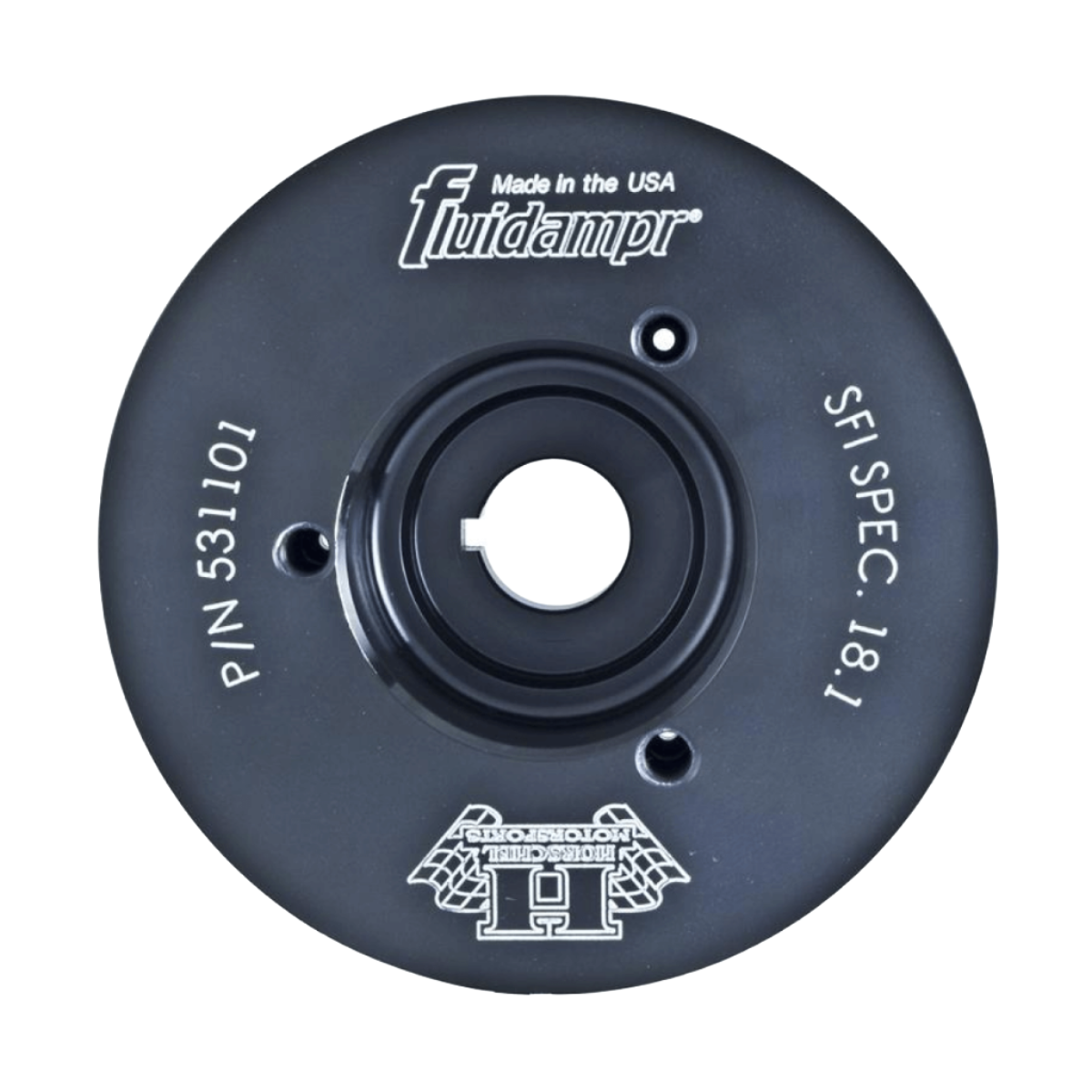
Fluidampr Harmonic Fluid Dampers Made in U.S.A.
KLM stocks a complete line of Fluidampr Harmonic fluid damper products. To
check pricing, please visit the
Fluidampr Harmonic
fluid damper section in the KLM Store.
 Each
time the air/fuel mixture inside a cylinder is ignited, the combustion that
occurs creates a torque spike that is applied to the crankshaft through the
piston and rod. This torque spike is so severe that it not only turns the
crankshaft, it actually twists the crankshaft ahead of its normal rotation and
then the crankshaft rebounds.
This twisting action is known as torsional vibration. When
these torque spikes and forces get into phase with the natural frequency,
critical torsional harmonic vibrations occur and can be seriously destructive to
the bearings and the crankshaft. Dampers are designed to control those
destructive vibrations.
Fluidampr Products and Fluidampr FAQs:
Rubber vs. Silicone Fluid
Critical harmonic vibrations occur numerous times
in a engine’s operating range. Stock rubber and elastomer-type dampers are
frequency sensitive “tuned absorbers”, and work at only one critical frequency.
In the case of a stock rubber damper, it is tuned for a factory engine’s
critical harmonic vibrations.
If you change the mass of pistons, rods, or the
crankshaft, you change the natural frequency of the crankshaft assembly;
therefore, the stock damper is no longer tuned to the new frequency of
vibration, and you may be headed for early failure of expensive engine
components. Dampers also create heat while they work, and rubber is a poor
dissipator of heat. This heat and the exposure to the elements deteriorates
rubber, causing it to crack and change durometer, which then leads to inertia
ring slippage, damper failure, uncontrolled torsional vibration, and costly
engine parts breakage.
|
If your damper looks like this... |
You need one of these... |
It's
important for the damper on your diesel engine to function properly . If your
damper looks like this, you need to replace it before major damage occurs. Stock
elastomeric dampers have a short life span and do not control torsional
vibrations at all RPM's. The rubber rings in stock dampers deteriorate.
Fluidampr offers a superior performance that lasts. |

A new Fluidampr on your diesel truck will not
only protect your engine from destructive torsional vibrations but will also
increase TORQUE & HORSEPOWER. High performance diesel engines running chips and
programmers are exceptionally vulnerable to torsional vibrations. Save your
crank & more by installing a new Fluidampr today. |
Crankshaft Deflection
Each
time the air/fuel mixture inside a cylinder is ignited, the combustion that
results creates a torque spike - an extremely rapid rise in cylinder pressure.
This pressure, applied to the top of the piston, becomes the force that is
applied to the crankshaft through the connecting rod. Each torque spike is like
a hammer blow. In fact, it hits with sufficient intensity that it not only
causes the crankshaft to turn, it actually deflects or twists it.
This twisting action and the resulting rebound (as the crank arm
snaps back in the opposite direction) is known as torsional harmonic vibration.
If not adequately controlled, torsional vibration causes rapid main bearing and
main journal wear and possible crankshaft breakage.
Fortunately, harmonic vibration can be controlled by a
vibration damper - which is also called a harmonic damper or erroneously a
"harmonic balancer". The main purpose of a "harmonic damper" is to control
harmonic vibration, not necessarily to balance the engine's rotating assembly.
Although
harmonics occur over a broad range of engine speeds, rubber and elastomer-type
dampers are frequency sensitive - they are tuned only to control harmonic
vibrations that occur within a narrow band of rpm. However, there is more than
one area within the operating range of a performance engine that critical
harmonic vibrations occur, therefore, elastomer dampers may not be effective.
The resulting lack of vibration control could prove to be very
destructive. Rubber is also a poor dissipator of heat, and dampers by their
nature create heat as they work to reduce vibration. As the rubber gets hotter,
it does not work as well. Second, rubber breaks down when exposed to the
elements. Over time, the rubber strip can crack and begin to deteriorate due to
age and exposure. This can lead to inertia ring slippage, damper failure, and
uncontrolled torsional vibration, which leads to costly parts breakage.
Fluidampr
Facts
1.) Most stock dampers are actually tuned absorbers and do not
work when the the engine is modified from the original set-up. 2.) The damper is
not a balancer. It's job is to control torsional vibrations. 3.) The silicone
inside a Fluidampr will not expire and is not effected by temperature change.
4.) An externally balanced assembly should be balanced with only the
counterweight or stock damper installed.

Viscous Dampers
The
best dampers on the market are manufactured in the U.S.A. by Horschel
Motorsports, an ISO 9001:2000 certified facility. HM is continuing the tradition
that started in 1946, when the first viscous damper was invented. Over 4 million
viscous dampers have been made for heavy duty diesel, drag car, stock car,
street machine, race boat and other high performance engines. Looking into the
future, Horschel Motorsports promises to manufacture the best dampers available
as well as engineering new solutions for developing engine technologies.
The Fluid in a Fluidampr
It has been rumored that the fluid in a Fluidampr turns to gel
over time. Here’s a news flash, its gel when we pump it into the damper. That is
how the technology works. The silicone gel inside the damper keeps the flywheel
in place and functioning. So to put all of the competitions claims to rest, it
is a gel, always and forever. Maybe we should have named them Geldamprs.
Let’s Talk About Rubber
Other dampers on the market use rubber or “elastomer” as the
insulator for the internal flywheel. Rubber deteriorates and wears down from
repeated movements. In layman’s terms, the more you work it, the weaker it will
get. The inertia ring that balances an elastomeric damper becomes unstable when
the o-rings start to wear. Think of it this way, what does a car wheel feel like
when it looses one of its balancing weights? How would a fan missing a blade
function? A damper with worn o-rings can unbalance a crankshaft and destroy it.
The reason car manufactures install elastomer dampers at the
factory is not for performance but for cost. The “rubber” dampers are cheaper
and easier to make.

VISIT OUT ONLINE STORE TO PURCHASE A
FLUIDAMPR HARMONIC FLUID DAMPER
CALL US TODAY TO PURCHASE A FLUIDAMPR
HARMONIC FLUID DAMPER
|